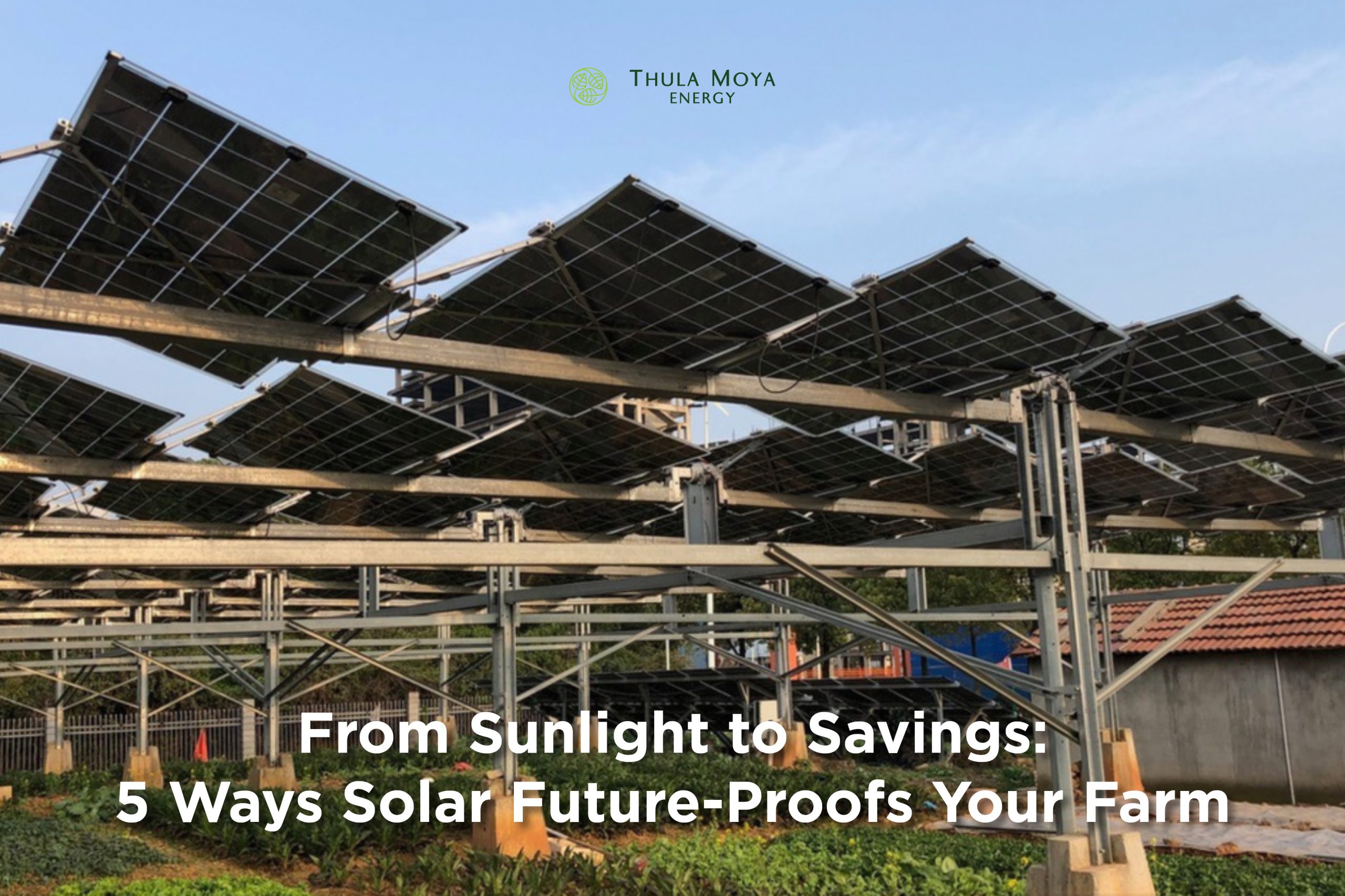
Running a farm in the current South African economic climate isn’t for the faint-hearted, and if you’ve written off solar as some city-slicker gimmick, you aren’t alone. But these myths are really costing you money.
As professionals in the EPC field, we have our fingers on the pulse in energy in South Africa, so when we say that diesel costs are a gamble, and Eskom’s failing grid structure is an area of huge concern, we know that it affects your operations on your farm. We see the tariff hikes going up every year and cringe with you because we know it hits the bank harder than a mid-season drought. For many in the business, and farmers in particular, energy is one of the few major costs you can fully control. What was once perceived as an experimental tech reserved for the generationally wealthy is now becoming a proven and bankable asset that many South African farmers are cashing in on.
We won’t try to greenwash or hit you over the head with tree-hugging propaganda, (because the sustainability benefits to the environment speak for themselves) but we will say that going solar can greatly reduce your operational costs on the bottom line, protecting your investment and securing your farm’s legacy. The technology has matured, the numbers make sense, so the only barrier now is awareness.
Below you’ll find five no-nonsense reasons solar belongs in your farm’s toolkit. Think of it like it’s a survival kit for dealing with power outage roulette, diesel woes and generator struggles, and the ever-tightening pinch on your hard-earned profits.

Often the single biggest expense in greenhouse operations, farmers can reduce their energy costs by up to 70% by switching to solar, converting rising grid prices into profit over time. Source: Neosun.com
Stable Electricity Pricing for 20 – 25 years
When you make deals for your seed and fertiliser, you lock them in for a price that works best for you. Why aren’t you doing the same for your electricity every month?
Solar lets you fix your electricity input costs for decades to come, and that means no more 12% tariff hikes every April, and no more hopeless praying that Eskom doesn’t collapse during harvest season.
A properly designed solar PV system that matches your farm’s energy profile (whether it’s irrigation pumps, cold storage, or processing sheds) also means you get predictable operational expenses, which means better financial planning, which means less stress, and more savings.
Real example: On a R1.2 million solar setup for a mid-sized citrus farm in Limpopo, the monthly Eskom bill dropped by R25,000 and over 20 years that becomes R6 million in savings. Not too shabby, hey?
And solar panels with inverters and a battery energy storage system isn’t risky tech. The panels come with 25-year warranties, inverters last 10 to 15, and most solar batteries on the market today will last somewhere between five and 15 years. As your preferred EPC partner, we will come out and clean your panels twice a year and provide you with full-stack support 24/7 if anything happens that you aren’t too sure about. It’s a quick learning curve, the maintenance is minimal, and our systems are designed to be modular, so you can scale over time.
Quick Note on Power Purchase Agreements (PPAs): If you want to go solar but prefer to avoid the upfront capital spend, a Power Purchase Agreement (PPA) might be an option. Under a PPA, we install and maintain the system at no upfront cost, and you simply buy the electricity at a fixed, predictable rate, often lower than Eskom, for 10 to 20 years. You get the savings and stability; we handle the headaches. It’s like leasing your tractors instead of buying them outright.
Solar Panel Tax Rebate with Section 12BA Tax Allowance
Under Section 12B of the Income Tax Act, businesses can claim a 100% capital deduction in the first year for the cost of a solar PV system, including panels, inverters, installation, and related infrastructure. That means your entire solar investment can be written off against taxable income in the year of purchase.
Example: Spend R1 million on a qualifying solar setup, and if your company’s taxed at 27%, that’s R270,000 less paid to SARS.
What qualifies?
• Systems must be used for generating electricity (not just heating).
•They must be owned and used by your business (not leased).
• The deduction includes panels, supporting structures, inverters, wiring, and installation costs.
This incentive drastically shortens your payback period. Combine it with energy savings, and solar starts paying for itself almost immediately, and in some cases, inside three years.
It’s important to note that SARS doesn’t automatically apply this, your accountant must claim it in your return. If they aren’t talking about Section 12B, you need a new accountant.
Push Excess Power Back into the Grid, and Earn Credits on Your Next Bill
If you have more sunlight than you know what to do with, then it’s a good thing. Some areas in South Africa, especially in the Western Cape and parts of KZN, now let you feed excess power back into the grid. Some co-ops are doing net metering, where members share and credit each other.
So, it should come as no surprise that farmers are already selling excess power back or using it to offset any community costs. A recent article by Neosun Energy (link at the bottom of the article) highlights that solar-fed pumping stations and microgrids are turning remote farms into energy hubs.
By doing this, you are turning your farm into more than just a business, you’re generating passive income through your business as a small utility.
Remote Monitoring and Full Control
As an EPC with a special place in our hearts for agriculture, we know it’s not wise to leave your irrigation system unchecked for a week, so why do it with your energy system? Our modern systems come with remote monitoring apps which allows you to check output, consumption, battery status, and any fault alerts on your phone.
Learn more about our remote monitoring app here.
Fact: According to INRAE, smart monitoring has improved system uptime by over 15% in agricultural deployments, meaning less downtime, less guessing, and faster fixes.
Let’s be honest. Knowing that your cold room is running, or your borehole pump isn’t dead, is peace of mind.
Boost Land Value and Save on Water Pumping
If your farm is near the edge of the grid or fully off it, every diesel litre you burn is bleeding cash. Solar pumping solutions let you run boreholes, pivot systems, and trough feeds without fuel. You save operational cost AND reduce wear and tear on your backup generators.
Properties with embedded solar systems are worth more, and we know that not only do banks like stable OPEX, but buyers like energy resilience, thereby adding real, tangible value to your property if it ever comes down to that.
Most agricultural equipment can now run off renewables, not only is it more efficient, but it’s economically smarter. Plus, in the long run, a solar system isn’t only a cost-saving measure, it’s a farm asset that works silently in the background for every day the sun rises.
Final Thought
You don’t have to go full solar overnight. Simply starting with your cold room, borehole or the Eskom-heavy outbuilding, and you’ll see the numbers yourself. If you’re impressed, you’ll immediately want to scale to other areas, and that’s where we will help you too. Our custom-designed solar PV systems pay for themselves in under five years (depending on the size of the system and how much power is generated). After that, it’s literally just free electricity for decades. No frills, no catch, no ifs or buts.
Through our experience with Frost Farming and Elton Dairy Farming, both in KZN, we know and understand just as well as you do that being a farmer also means running a business, and we also know that no smart business owner ignores a proven way to cut their costs and boost their asset values.
The best time to go solar was yesterday. The next best time? Now.
Not sure where to start?
We’ll walk your site, run the numbers, and show you the ROI. Call us today for an obligation free quote, and you can take it from there.
LinkedIn | Facebook | Instagram
Further Reading:
- Solar Power for Agriculture: How Solar Energy Can Transform and Help Agribusiness – Neosun
- Use of solar power in agriculture – FarmingFarmersFarms
- The cost structure of solar energy systems for farms – Journals.co.za
- SARS Section 12B: Solar Panel Tax Rebate – SARS
- Renewable Energy Incentives for Businesses – TaxTim